
By Karachi Psychiatric Hospital Editorial Team | Medically Reviewed by Consultant Psychiatrists | Sep 2026
Mania and hypomania may look similar since in both instances there are alterations in mood, energy, sleep, activity, speech, and behavior. The main differences are in the severity, the impact on functioning, the duration, the occurrence of psychosis, and the need for hospitalization. While both can occur in individuals with bipolar disorder they cannot be treated as if they are the same. It could be useful to keep a record of sleep and behavior when evaluating the condition.
What Is A Manic Episode?
A manic episode is a distinct period during which there is an abnormally elevated, expansive, or irritable mood, along with increased energy or activity and other changes in behavior.
NIMH defines Bipolar I disorder by manic episodes lasting at least 7 days or severe enough to require hospital care. Mania can substantially affect work, relationships, judgment, finances, and daily responsibilities.
During a manic episode, a person may:
- Sleep very little without feeling tired
- Talk much more or faster than usual
- Feel unusually important, talented, powerful, or confident
- Become easily distracted
- Start many activities or projects
- Spend excessively or take financial risks
Severe mania can show itself in the form of psychotic symptoms such as hallucinations or delusions; in these instances, when the symptoms are severe enough to necessitate hospitalization, the condition is termed mania and not hypomania.
What Is A Hypomanic Episode?
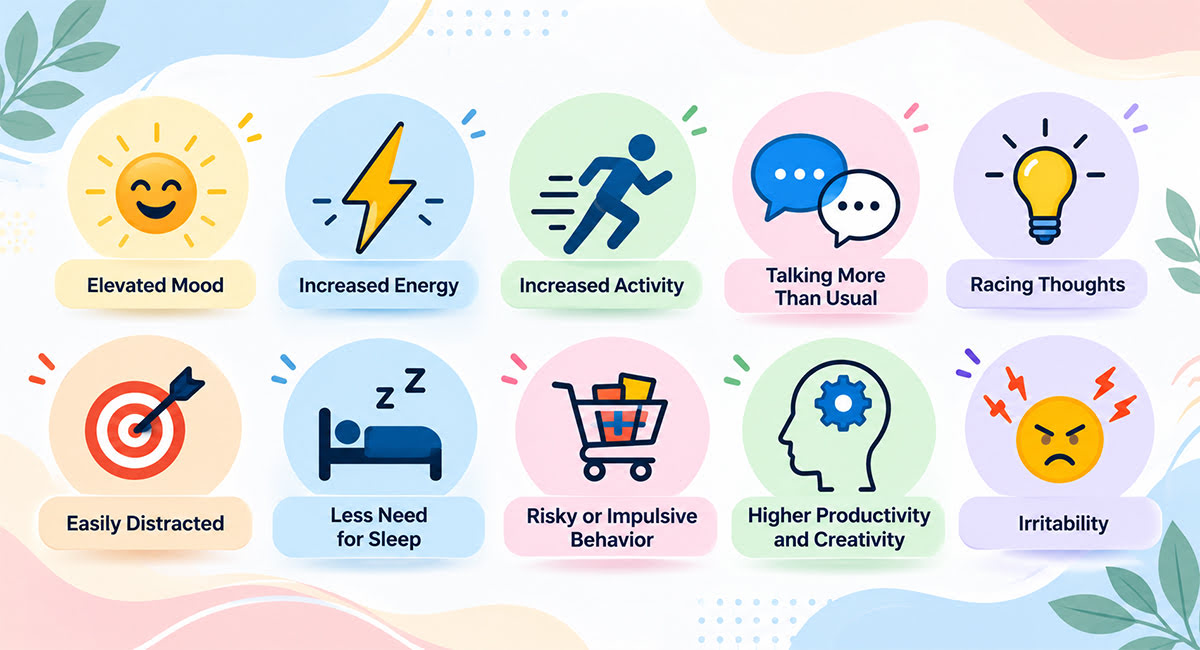
Hypomania has basically the same symptoms as mania, but they are less severe. A person may feel increased energy, need less sleep, talk more quickly, have racing thoughts, feel more confident, or act in a more goal-directed way.
NIMH describes hypomania as a milder form of mania. Under current diagnostic criteria, a hypomanic episode lasts at least 4 consecutive days and represents a clear change from usual functioning. The change does not cause marked impairment, require hospitalization, or include psychotic features.
Common signs include:
- Increased energy and activity
- Sleeping less than usual
- Racing thoughts
- Talking more quickly or frequently
Hypomania can still affect relationships, work, spending, sleep, and decisions.
How Long Do Mania and Hypomania Last?
The DSM-5-TR says that a manic episode typically lasts for at least seven days, though it could occur sooner if the symptoms are severe enough to require hospitalization. A hypomanic episode generally lasts for at least four consecutive days.
Just thinking about how long the condition has lasted is not sufficient for making a diagnosis; the psychiatrist also takes into account the severity, any prior episodes, the patient’s medical history, the medications they are currently taking, their substance use, and any possible medical causes.
Mania vs Hypomania: Quick Comparison
| Feature | Mania | Hypomania |
|---|---|---|
| Severity | More severe | Less severe |
| Typical duration threshold | At least 7 days, or shorter if hospitalization is required | At least 4 consecutive days |
| Functional impact | Can cause marked impairment | Noticeable change without marked impairment |
| Psychosis | May occur | Not present during hypomania |
| Hospitalization | May be required | The episode itself does not require hospitalization |
When carrying out an assessment, psychiatrists can inquire as to any changes in the individual’s normal sleep pattern, in their speech, in their level of activity, in the way they spend money, in their judgment, in previous episodes, in their medications, in their substance use, and in the changes that have been observed by their family members.
Can Other Conditions Cause Similar Symptoms?
The fact that there is a change in sleep, energy, concentration, mood, or behavior does not prove that mania or hypomania is present; things similar to these symptoms may be caused by sleep deprivation, medical conditions, prescribed medications, alcohol, and other substances.
The diagnosis considers when the symptoms occurred, any prior episodes, the person’s medical history, the medications they are currently taking, their substance use, their family history, and their level of functioning. None of the things like a single blood test, a brain scan, or any other laboratory test is able to confirm a diagnosis of bipolar disorder; it is instead made on the basis of a clinical assessment and the person’s history.

How Are Mania And Hypomania Related To Bipolar Disorder?
Mania and hypomania are associated with different forms of bipolar disorder; in the case of bipolar I disorder, there is at least one manic episode, while bipolar II disorder involves hypomanic episodes as well as major depressive episodes, without a previous history of a manic episode. People who have ever experienced a manic episode are not eligible for a diagnosis of bipolar II.
According to NIMH, bipolar disorder involves episodes of marked mood changes accompanied by shifts in energy, activity, and concentration.
For people seeking bipolar disorder treatment in Karachi, a qualified psychiatric assessment can review symptoms and history before discussing suitable treatment options.
Related read: What Is Bipolar Disorder and Why Should You Take It Seriously?
Can Mania Or Hypomania Happen Without Bipolar Disorder?
Mania is not limited to people with Bipolar I disorder, and symptoms similar to it may also be caused by medication, substances, or a number of medical conditions. In the same way, symptoms resembling hypomania can also be due to other causes.
That is why it is not sufficient merely to have some of the symptoms as listed on an online checklist in order to receive a diagnosis of bipolar disorder; a psychiatrist takes into account the person’s complete history, the duration and pattern of the symptoms, any prior episodes, the use of medications or substances, any existing medical conditions, and the level of the person’s functioning.
When Should You Seek Professional Help?
It would be advisable to contact a qualified psychiatrist if there are considerable changes in mood, sleep, energy, judgment, or behavior that either continue or begin to interfere with your daily life.
Professional help is particularly important when:
- Sleep becomes extremely limited
- Risky or impulsive behavior is increasing
- Work, studies, or responsibilities are affected
- Spending or other decisions become unusually risky
- Relationships are seriously affected
- The person appears disconnected from reality
- There may be a risk of self-harm or harm to others.
If someone is experiencing a loss of contact with reality or displaying dangerous behavior, prompt medical or emergency intervention is recommended.
Bipolar disorder is treated on an individual basis and can include the use of medication, psychotherapy, psychoeducation, assistance with making lifestyle changes, help for the family, and routine psychiatric check-ups. The treatment has to be carried out by a qualified mental health professional.

How Can Karachi Psychiatric Hospital Help?
The Karachi Psychiatric Hospital (KPH) provides psychiatric care and assessment for people who have a range of mental health problems, and an accurate evaluation can aid in deciding whether the symptoms are a result of bipolar disorder or some other condition.
If you are looking to for the best psychiatrist in Karachi, you should consider their professional qualifications, the clinical experience they have, their method of communication, their diagnostic approach, and the quality of the care they provide, rather than relying just on promotional claims.
Anyone who is going through major changes in their mood, sleep patterns, energy levels, or behavior can get in touch with the Karachi Psychiatric Hospital to talk about having a psychiatric assessment.
Book a consultation.
FAQs
What is the main difference between mania and hypomania?
Mania is more severe and can cause marked disruption in work, relationships, judgment, or daily functioning. Hypomania is milder and does not cause marked impairment or psychosis.
Can hypomania occur with bipolar disorder?
Yes. Hypomanic episodes occur in Bipolar II disorder and can also occur in Bipolar I disorder. Diagnosis depends on the complete history.
What are common signs of a manic episode?
Common signs include decreased need for sleep, increased energy, rapid speech, racing thoughts, distractibility, unusually high confidence, increased activity, risky decisions, and impulsive behavior.
When should someone seek help for mania or hypomania?
Seek professional help when changes in mood, sleep, energy, judgment, or behavior affect daily life, relationships, responsibilities, or safety.
Can someone have hypomania without having bipolar disorder?
Hypomania-like symptoms can occur for different reasons, including substances, medications, and medical conditions. Whether symptoms meet criteria for bipolar disorder depends on the complete clinical picture and professional assessment.
References & Further Reading
- National Institute of Mental Health. Bipolar disorder.
- American Psychiatric Association. Bipolar disorders.
- American Psychiatric Association. Diagnostic and Statistical Manual of Mental Disorders, Fifth Edition, Text Revision (DSM-5-TR).
Medical Disclaimer: This article is intended for general educational purposes and does not provide a diagnosis or replace an evaluation by a qualified mental health professional. Symptoms such as changes in sleep, energy, mood, or behavior can have different causes. If you are concerned about yourself or someone else, seek professional medical advice.